Octubre es Speaker Month
Los monitores más deseados al -10% de descuento
Nuevos planes de financiamiento
Octubre es Speaker Month
Los monitores más deseados al -10% de descuento
Nuevos planes de financiamiento
Octubre es Speaker Month
Los monitores más deseados al -10% de descuento
Nuevos planes de financiamiento
Octubre es Speaker Month
Los monitores más deseados al -10% de descuento
Nuevos planes de financiamiento
Octubre es Speaker Month
Los monitores más deseados al -10% de descuento
Nuevos planes de financiamiento
Octubre es Speaker Month
Los monitores más deseados al -10% de descuento
Nuevos planes de financiamiento


- Todas las categorías
Tu carrito
Elige tu ubicación
-
Evolution HQ
Free
Usually ready for pickup in 24 hours
75 9th Ave, New York, NY 10011, USA
📞 (+1) 212-456-7890
🕐 Mon – Fri: 8:30 am – 10:30 pm
Sat: 8:30 am – 10:30 pm
Sun: Closed -
Downtown Branch
$5 Same-Day Pickup
Ready within 6 hours
240 Broadway, New York, NY 10007, USA
📞 (+1) 212-987-6543
🕐 Mon – Sun: 9 am – 9 pm -
Queens Service Center
Free
Ready next business day
89-10 Queens Blvd, Elmhurst, NY 11373, USA
📞 (+1) 917-555-3344
🕐 Mon – Fri: 9 am – 8 pm
Sat: 10 am – 6 pm
Sun: Closed
Product Comparison
How they are Different
|
__ __ |
|
|---|---|
| Description |
Description - __ |
| Rating |
Rating - __ |
| Vendor |
Vendor - __ |
| Color |
Color - __ |
|
|
Comparar productos ( / )
58 productos
58 productos
Ordenar por:
- Características
- Más relevantes
- Más vendidos
- Alfabéticamente, A-Z
- Alfabéticamente, Z-A
- Precio, menor a mayor
- Precio, mayor a menor
- Fecha: antiguo(a) a reciente
- Fecha: reciente a antiguo(a)

$7,999 Dólares
Desde la década de 1950, el Neumann M 50 se ha considerado el micrófono ideal para grabaciones orquestales y orquestación de cuerdas. Con su fenomenal respuesta transitoria y su característica direccional única, este micrófono clásico ha conquistado a numerosos aficionados, tanto en la sala de control como en el estudio de sonido.
El nuevo Neumann M 150 Tube retoma muchas de las características del M 50 original y las incorpora en un micrófono muy moderno. Con bajo ruido propio, membrana y cápsula de titanio, amplificador de válvulas sin transformador y una sofisticada fuente de alimentación, el M 150 Tube no es una reedición, sino un micrófono completamente nuevo.
Características acústicas:
El diafragma de titanio de la cápsula de presión tiene 12 mm de diámetro y es extremadamente delgado. Si bien el titanio es conocido desde hace tiempo por sus características únicas y deseables, hasta hace muy poco era muy difícil conseguirlo con la calidad necesaria para su uso en un micrófono de este tipo.
La rejilla del cabezal tiene la misma forma que la del M 50 original, a petición de varios ingenieros de renombre de la industria discográfica. Gracias al montaje de la cápsula de presión con el diafragma a ras de la superficie de una pequeña esfera (40 mm), la característica direccional del M 150 Tube es completamente única.
En las frecuencias más bajas, este sistema es un transductor de omnipresión puro con un patrón polar perfectamente circular. Sin embargo, en las frecuencias medias y altas, el patrón de captación se vuelve más estrecho. El M 150 Tube es un micrófono ideal para cualquier grabación estéreo, envolvente 5.1 o 7.1, especialmente la técnica DECCA Tree.
Características eléctricas:
El rango dinámico del M 150 Tube es de 119 dB, lo que permite la reproducción de la expresión musical completa, sin restricciones.
Con un bajo ruido propio de 15 dB-A, se puede utilizar más ganancia sin riesgo de añadir ruido al producto final. El circuito de salida sin transformador de este micrófono permite una reproducción extremadamente fina de señales pequeñas e información de baja frecuencia. Además, se pueden utilizar cables largos sin pérdida de calidad de la señal.


$899 Dólares
The TLM 102 defines a new generation of Neumann studio microphones. This applies not only to the design of the microphone but also to the price. Technical Data
The TLM 102 is impressive in terms of sound: In the interior is a newly developed large-diaphragm capsule (cardioid) with a maximum sound pressure level of 144 dB, which permits the recording of percussion, drums, amps and other very loud sound sources, for example. Instruments that are not especially loud also benefit from the very fast transient response of the TLM 102. However its most important applications are in the realm of vocals and speech; a slight boost above 6 kHz provides for excellent presence of the voice in the overall mix. Up to 6 kHz the frequency response is extremely linear, ensuring minimal coloration and a clearly defined bass range. The capsule has an elastic suspension for the suppression of structure-borne noise. A pop screen integrated into the grille serves to suppress plosives in vocal and speech recording.
Due to its price and flexible field of application, the TLM 102 is ideal for the home recording and project studio sector, as well as for the broadcasting area, especially when clear lines of sight to the speakers are a priority.
Features
Acoustical operating principle
Pressure gradient transducer
Directional pattern
Cardioid
Frequency range
20 Hz ... 20 kHz
Sensitivity at 1 kHz into 1 kohm
11 mV/Pa
Rated impedance
50 ohms
Rated load impedance
1 kohms
Equivalent noise level, CCIR1)
21 dB
Equivalent noise level, A-weighted1)
12 dB-A
Signal-to-noise ratio, CCIR1) (rel. 94 dB S.P.L)
73 dB
Signal-to-noise ratio, A-weighted1) (rel. 94 dB S.P.L)
82 dB
Maximum S.P.L for THD 0.5%2)
144 dB
Maximum output voltage
13 dBu
Supply voltage (P48, IEC 61938)
48 V ± 4 V
Current consumption (P48, IEC 61938)
3.5 mA
Matching connector
XLR3F
Weight
approx. 210 g
Diameter
52 mm
Length
116 mm


$12,499 Dólares
Presentado en 1951, el M 50 se convirtió en el referente de la grabación clásica y fue fundamental en el desarrollo de la técnica Decca Tree, gracias a su excepcional respuesta transitoria y su patrón polar único. Si bien es omnidireccional en bajas frecuencias, el M 50 se vuelve gradualmente más direccional en altas frecuencias. El Neumann M 50 V es una reedición fiel según las especificaciones originales, utilizando documentación del archivo Neumann.
DISEÑO LEGENDARIO
Desarrollado en estrecha colaboración con la Nordwestdeutscher Rundfunk (Radiodifusión del Noroeste de Alemania), el M 50 fue la contraparte del no menos legendario M 49. Si bien este último era un micrófono multiusos de alta calidad para diversos entornos acústicos, el M 50 fue diseñado como el micrófono con transductor de presión definitivo para salas de conciertos y espacios de grabación especializados.
En la práctica, esto significó que el M 50 se usara principalmente para grabar orquestas, por ejemplo, como la pastilla principal en diversas configuraciones omnidireccionales espaciadas. En la década de 1950, cuando el sello discográfico Decca experimentó con técnicas de microfonía estéreo, se probaron diversas configuraciones, micrófonos y patrones de captación. Finalmente, se seleccionó el Neumann M 50 como la opción perfecta para lo que ahora se conoce como configuración Decca Tree, es decir, tres micrófonos montados en triángulo con los micrófonos exteriores orientados hacia afuera. Hasta el día de hoy, una configuración Decca Tree, a menudo ampliada con estabilizadores adicionales, que utiliza micrófonos Neumann M 50 sigue siendo la opción preferida por ingenieros experimentados en música clásica y bandas sonoras. La vívida imagen de esta configuración, combinada con la excelente resolución del M 50, produce resultados incomparables. Hoy en día, se utilizan versiones ampliadas de esta técnica para grabaciones envolventes e inmersivas. Por supuesto, el M 50 también ha producido excelentes resultados en otras aplicaciones, por ejemplo, grabaciones de piano o como micrófono puntual para secciones de cuerda y solistas. En contextos pop, el M 50 se ha utilizado para microfonear conjuntos o secciones de metales y como micrófono de sala, por ejemplo en baterías.
PROPIEDADES ÚNICAS
El M 50 V es una fiel reedición de los históricos micrófonos M 50, producidos por Neumann entre 1951 y 1971. Utiliza el mismo concepto acústico con una cápsula omnidireccional de diafragma pequeño, empotrada en una esfera acrílica de 40 mm. Este diseño produce un patrón polar único, omnidireccional a bajas frecuencias y gradualmente más direccional por encima de los 1000 Hz. Al mismo tiempo, la respuesta en frecuencia muestra un ascenso suave hacia las frecuencias más altas, compensando la pérdida de agudos en el campo difuso y otorgando al micrófono un mayor alcance. Al ser un auténtico transductor de presión, el M 50 ofrece una potente respuesta de graves hasta frecuencias subsónicas, sin efecto de proximidad. Asimismo, su creciente directividad a altas frecuencias ofrece una imagen óptima en configuraciones estéreo, envolventes e inmersivas.
COMPARADO CON SUS PREDECESORES
El M 50 V combina la sonoridad original con una estabilidad térmica y a largo plazo mejorada. El M 50 V utiliza el mismo circuito que la última versión, el M 50 c, que ofrecía mejoras considerables en el rendimiento acústico y el rango dinámico. Solo el tubo Telefunken AC701k, ya no disponible, ha sido reemplazado por uno con un ruido aún más bajo, también en formato subminiatura. En lugar de la cápsula K 83 presente en los micrófonos M 50 b y c posteriores, el M 50 V emplea la K 33 Ti, que representa un retorno al diseño acústico original con un diafragma metálico ultrafino que ofrece una respuesta transitoria excepcional. En comparación con las antiguas cápsulas K 53, la K 33 Ti ofrece una estabilidad térmica y a largo plazo mejorada, ya que toda la cápsula, incluida su membrana ultrafina, está hecha de titanio.
CARACTERÍSTICAS DEL NEUMANN M 50 V:
- Reedición del legendario M 50 con mejoras de detalles
- Cápsula omnidireccional única montada en una esfera de 40 mm
- Circuito clásico de válvulas con transformador de salida
- La mejor opción para grabaciones orquestales, especialmente Decca Tree
- Fabricado según especificaciones originales utilizando documentación archivada
- La nueva fuente de alimentación se adapta automáticamente a la tensión de red
- Hecho a mano y soldado a mano en Alemania.


El KH 805 II es el subwoofer perfecto para salas de tamaño mediano, ya que ofrece una amplificación de graves con la precisión de Neumann. Incluye un gestor de graves único y flexible para sistemas estéreo y también puede utilizarse en configuraciones envolventes e inmersivas para reproducción LFE o con gestión de graves externa. Las entradas y salidas analógicas y digitales permiten una conectividad flexible.
Subwoofer de próxima generación
El KH 805 II mejora a su predecesor en rendimiento acústico y añade nuevas características. Gracias a un novedoso woofer de 10" de largo alcance con tecnología ELFF™ (Factor de Fuerza Extremadamente Lineal) y limitadores de protección inteligentes, el KH 805 II garantiza una distorsión excepcionalmente baja incluso con niveles de presión sonora máximos.
El KH 805 II extiende la reproducción de bajas frecuencias hasta 16 Hz y ofrece aproximadamente el doble de potencia que el DSP del KH 750. Esto lo convierte en el complemento perfecto para altavoces de tamaño mediano como el KH 150 y el KH 310.
El KH 805 II está controlado por DSP para un rendimiento sonoro superior y una integración perfecta mediante la alineación automática de monitores MA 1 (se vende por separado). Al combinarse con monitores de estudio analógicos Neumann como el KH 120 A (descatalogado), el KH 310 o el KH 420, ofrece suficiente potencia DSP para alinear todo el sistema estéreo mediante MA 1, optimizando no solo la respuesta en frecuencia, sino también la fase. Por lo tanto, el KH 805 II es... Una mejora significativa para los sistemas existentes. Por supuesto, el KH 805 II también es el complemento perfecto para los monitores de estudio con DSP de Neumann.
Precisión en cada detalle
Dado que los subwoofers suelen colocarse en el suelo, una robusta rejilla protege el altavoz de daños accidentales. El gabinete rígido cuenta con un sistema bass reflex de alta eficiencia, cuidadosamente diseñado y ajustado para una reproducción de graves nítida, con un ruido de puerto inaudible.
Las dos entradas XLR analógicas están balanceadas electrónicamente, al igual que las dos salidas XLR analógicas. La entrada digital (BNC) de hasta 192 kHz / 24 bits acepta señales AES3 y S/P-DIF. El subwoofer cuenta con una función de espera automática, que se puede desactivar mediante un interruptor en la placa trasera.
El KH 805 II destaca en estudios de música, radiodifusión y postproducción para grabación, mezcla y masterización.
Beneficios
- Ampliación de graves del sistema de monitorización hasta 16 Hz
- Aumentar el SPL máximo de todo el sistema
- Disminución de la distorsión armónica y de intermodulación de los altavoces
- MA 1 Ready para una alineación perfecta de todo el sistema y una integración perfecta del subwoofer. Para configuraciones multicanal, ofrecemos la opción de extensión multicanal MA 1.
- MA 1 integración de altavoces analógicos KH Line, suficiente potencia DSP para un sistema estéreo completo.


$1,750 Dólares
The KM 184 (cardioid) in particular has become the classic high-quality miniature microphone. Now also available in attractive stereo sets, with cardioid, hypercardioid or omni directional characteristics. The "Series 180" consists of three compact miniature microphones with patterns that satisfy the demands of all common studio applications. Because of its optimized mechanical construction and conscious omission of modularity, which is unnecessary in many cases, the "Series 180" is predestined for economy-minded production and home recording studios. _________________________________________________ 1) according to IEC 60268-1; CCIR-weighting acccording to CCIR 468-3, quasi peak; A-weighting according to IEC 61672-1, RMS
The KM 183 is a pressure transducer with a boost of approximately 7 dB at 10 kHz in the free field. In the diffuse sound field it has a flat frequency response. The pressure gradient transducers KM 184 and KM 185 feature very smooth frequency responses not only for the 0° axis, but also for lateral (off-axis) sound incidence. In typical usage, there is no coloration of sound over a wide pickup angle.
Although the KM 184 has the same capsule as the KM 84, the microphone differs slightly on the 0° frequency response: The KM 184 has a gentle rise at about 9 kHz, a characteristic that was introduced very successfully with the KM 140. The result is a tonal balance that is fresher and livelier when compared to the KM 84 with its flat frequency response in that band.
This difference was achieved with just a slight change of the capsule’s rear opening, and is not due to resonances.
The KM 185 with its hypercardioid characteristic features attenuation of sound incidence from the side or rear of about 10 dB, with minimum sensitivity at an angle of 120°.
Compared to the KM 84 the dynamic range of the KM 184 increased by 24 dB mainly through the reduction of self-noise level to only 22 dB (CCIR) and an increased sound pressure handlingcapability of up to 138 dB.
The microphones operate without any problems, even if the input of following equipment happens to be unbalanced, for example as in some DAT recorders.
The output of the "Series 180", as in all Neumann microphones, is balanced and phantom (48V) powered.
Economy
The mechanical construction was simplified, for example, capsule and output stage cannot be separated from each other. For this reason the "Series 180" is an economical alternative without giving up the electroacoustic features the users expect from Neumann microphones.
Features:
KM 183 / 184 / 185
Acoustical operating principle
Pressure/Pressure gradient transducer
Directional pattern
omnidirectional/cardioid/hypercardioid
Frequency range
20 Hz ... 20 kHz
Sensitivity at 1 kHz into 1 kohm
12/15/10 mV/Pa
Rated impedance
50 ohms
Rated load impedance
1 kohms
Equivalent noise level, CCIR1)
24/22/24 dB
Equivalent noise level, A-weighted1)
13/13/15 dB-A
Signal-to-noise ratio, CCIR1) (rel. 94 dB S.P.L)
70/72/70 dB
Signal-to-noise ratio, A-weighted1) (rel. 94 dB S.P.L)
81/81/79 dB
Maximum S.P.L for THD 0.5%2)
140/138/142 dB
Maximum output voltage
10 dBu
Supply voltage (P48, IEC 61938)
48 V ± 4 V
Current consumption (P48, IEC 61938)
3.2 mA
Matching connectors
XLR 3F
Weight
approx. 80 g
Diameter
22 mm
Length
107 mm
2) measured as equivalent el. input signal

$899 Dólares
The KM 184 (cardioid) in particular has become the classic high-quality miniature microphone. Now also available in attractive stereo sets, with cardioid, hypercardioid or omni directional characteristics. The "Series 180" consists of three compact miniature microphones with patterns that satisfy the demands of all common studio applications. Because of its optimized mechanical construction and conscious omission of modularity, which is unnecessary in many cases, the "Series 180" is predestined for economy-minded production and home recording studios. _________________________________________________ 1) according to IEC 60268-1; CCIR-weighting acccording to CCIR 468-3, quasi peak; A-weighting according to IEC 61672-1, RMS
The KM 183 is a pressure transducer with a boost of approximately 7 dB at 10 kHz in the free field. In the diffuse sound field it has a flat frequency response. The pressure gradient transducers KM 184 and KM 185 feature very smooth frequency responses not only for the 0° axis, but also for lateral (off-axis) sound incidence. In typical usage, there is no coloration of sound over a wide pickup angle.
Although the KM 184 has the same capsule as the KM 84, the microphone differs slightly on the 0° frequency response: The KM 184 has a gentle rise at about 9 kHz, a characteristic that was introduced very successfully with the KM 140. The result is a tonal balance that is fresher and livelier when compared to the KM 84 with its flat frequency response in that band.
This difference was achieved with just a slight change of the capsule’s rear opening, and is not due to resonances.
The KM 185 with its hypercardioid characteristic features attenuation of sound incidence from the side or rear of about 10 dB, with minimum sensitivity at an angle of 120°.
Compared to the KM 84 the dynamic range of the KM 184 increased by 24 dB mainly through the reduction of self-noise level to only 22 dB (CCIR) and an increased sound pressure handlingcapability of up to 138 dB.
The microphones operate without any problems, even if the input of following equipment happens to be unbalanced, for example as in some DAT recorders.
The output of the "Series 180", as in all Neumann microphones, is balanced and phantom (48V) powered.
Economy
The mechanical construction was simplified, for example, capsule and output stage cannot be separated from each other. For this reason the "Series 180" is an economical alternative without giving up the electroacoustic features the users expect from Neumann microphones.
Features:
KM 183 / 184 / 185
Acoustical operating principle
Pressure/Pressure gradient transducer
Directional pattern
omnidirectional/cardioid/hypercardioid
Frequency range
20 Hz ... 20 kHz
Sensitivity at 1 kHz into 1 kohm
12/15/10 mV/Pa
Rated impedance
50 ohms
Rated load impedance
1 kohms
Equivalent noise level, CCIR1)
24/22/24 dB
Equivalent noise level, A-weighted1)
13/13/15 dB-A
Signal-to-noise ratio, CCIR1) (rel. 94 dB S.P.L)
70/72/70 dB
Signal-to-noise ratio, A-weighted1) (rel. 94 dB S.P.L)
81/81/79 dB
Maximum S.P.L for THD 0.5%2)
140/138/142 dB
Maximum output voltage
10 dBu
Supply voltage (P48, IEC 61938)
48 V ± 4 V
Current consumption (P48, IEC 61938)
3.2 mA
Matching connectors
XLR 3F
Weight
approx. 80 g
Diameter
22 mm
Length
107 mm
2) measured as equivalent el. input signal

$3,995 Dólares
In a word: The Neumann classic. Three directional characteristics and switchable pre-attenuation ensure suitability for a wide range of applications.
The Neumann U 87 Ai - voted as THE best microphone
The readers of the SOUND ON SOUND magazine have voted: U 87 Ai - the BEST MICROPHONE, announced during the Winter NAMM show 2012 in Anaheim, California.
The SOS award went to products, that "have made our lives in the studio all the more enjoyable". It is a further evidence for the reputation of the U 87 Ai as the world famous, professional standard studio condenser microphone. Until today the U 87 sets the mark in the microphone industry by which all others are measured.
The U 87 presents a wide range of features and versatility that make it to one of the most desirable mics available. Our users are recognising the microphone immediately by its distinctive design. Well-known for its warm and well balanced characteristics - your perfect choice as vocal microphone for all types of music and speech. The usage as main microphone for orchestra recordings or as spot mic for single instruments make it the most general-purpose microphone - in studios, for broadcasting, film and television.
The U 87* is equipped with a large dual-diaphragm capsule with three directional patterns: omnidirectional, cardioid and figure-8. These are selectable with a switch below the headgrille.
A 10 dB attenuation switch is located on the rear. It enables the microphone to handle sound pressure levels up to 127 dB without distortion.
Furthermore, the low frequency response can be reduced to compensate for proximity effect.
Applications
Users recognize the microphone immediately by its distinctive design. It is a good choice for most general purpose applications in studios, for broadcasting, film and television.
The U 87 Ai is used as a main microphone for orchestra recordings, as a spot mic for single instruments, and extensively as a vocal microphone for all types of music and speech.
Acoustic features
Polar patterns
Electrical features
The present-day circuitry increases the operational headroom of the U 87 Ai by supplying the bias voltages for the capsule through a reduced resistance. The result is a higher sensitivity of 10 dB for identical sound pressure levels, and an improved S/N ratio of 3 dB.
Filter and attenuation
An additional switch at the rear allows to change the microphone's cutoff frequency. This reduces low frequency interference directly at the input of the microphone amplifier.
This setting also compensates for the unavoidable bass boost that occurs with all pressure gradient transducers when they are used at close distance (proximity effect).
The cardioid characteristic maintains a smooth frequency response at a distance of 30 to 40 cm, the figure-8 characteristic even at a distance of 15 to 20 cm.
Features:
- Variable large diaphragm microphone
- Pressure-gradient transducer with double membrane capsule
- The studio microphone classic
- Three directional characteristics: omni, cardioid, figure-8
- Switchable low frequency roll-off
- Switchable 10 dB pre-attenuation
- Ideal as main and as support microphone in the most differing recording situations
These are just some of the most common applications. We recommend additional experimentation to gain maximum use from this microphone.
- For universal use
- The classical studio mic for vocalists (soloists and background vocalists)
- Announcer's mic for broadcasting, dubbing, voice-over
- Overhead
- Spot mic for wind instruments, strings (especially cello and double bass), piano, percussion
- Note: To record instruments with very high sound pressure levels we recommend our mics with TLM circuitry
| Acoustical operating principle | Pressure gradient transducer |
| Directional pattern | Omnidirectional, cardioid, figure-8 plus |
| Frequency range | 20 Hz ... 20 kHz |
| Sensitivity at 1 kHz into 1 kohm | 20/28/22 mV/Pa1) |
| Rated impedance | 200 ohms |
| Rated load impedance | 1 kohms |
| Equivalent noise level, CCIR2) | 26/23/25 dB1) |
| Equivalent noise level, A-weighted2) | 15/12/14 dB-A1) |
| Signal-to-noise ratio, CCIR2) (rel. 94 dB S.P.L) | 68/71/69 dB1) |
| Signal-to-noise ratio, A-weighted2) (rel. 94 dB S.P.L) | 79/82/80 dB1) |
| Maximum S.P.L for THD 0.5%3) | 117 dB (cardioid) |
| Maximum S.P.L for THD 0.5% with preattenuation3) | 127 dB |
| Maximum output voltage | 390 mV |
| Supply voltage (P48, IEC 61938) | 48 V ± 4 V |
| Current consumption (P48, IEC 61938) | 0.8 mA |
| Matching connectors | XLR3F |
| Weight | 500 g |
| Diameter | 56 mm |
| Length | 200 mm |
____________________________________________________
1)Omnidirectional / cardioid / figure-8
2) according to IEC 60268-1; CCIR-weighting acccording to CCIR 468-3, quasi peak; A-weighting according to IEC 61672-1, RMS
3) measured as equivalent el. input signal


$1,595 Dólares
Pocas piezas en existencia, reserve la suya. a la brevedad.
The new standard for home recording and the music industry. The mic for everyone who, despite budget limitations, does not want to do without the uncompromising Neumann sound. Cardioid directional characteristic and very low self-noise. These are just some of the most common applications. We recommend additional experimentation to gain maximum use from this microphone. ______________________________________________
By utilizing the tried and true transformerless circuit found in numerous Neumann microphones, the TLM 103 features yet unattained low self-noise and the highest sound pressure level transmission. The capsule, derived from that used in the U 87, has a cardioid pattern, is acoustically well-balanced and provides extraordinary attenuation of signals from the rear.
The TLM 103 is available in satin nickel and matte black. Delivery includes an SG 1 metal swivel mount and a wooden jeweler's box.
The large wire mesh headgrille protects the capsule from plosive sounds and effectively prevents pop noises. These characteristics are achieved without resorting to corrective resonance effects.
Therefore, the microphone maintains an excellent impulse response and reproduces the finest details of music and speech without coloration.
The letters TLM stand for "transformerless microphone". With TLM technology the usual output transformer is replaced by an electronic circuit. As with traditional transformers, it ensures good common mode rejection, and prevents RF interference that may influence the balanced audio signal.
Due to this low frequency extension, the TLM 103 is more sensitive to structure borne interference and wind noise. For such cases, the elastic suspension EA 1 and the windscreen WS 87 are available as accessories. For close vocal use, the PS 15 or PS 20 a pop screens are recommended.
Features:
Acoustical operating principle
Pressure gradient transducer
Directional pattern
Cardioid
Frequency range
20 Hz ... 20 kHz
Sensitivity at 1 kHz into 1 kohm
23 mV/Pa
Rated impedance
50 ohms
Rated load impedance
1 kohms
Equivalent noise level, CCIR1)
17.5 dB
Equivalent noise level, A-weighted1)
7 dB-A
Signal-to-noise ratio, CCIR1) (rel. 94 dB S.P.L)
76.5 dB
Signal-to-noise ratio, A-weighted1) (rel. 94 dB S.P.L)
87 dB
Maximum S.P.L for THD 0.5%2)
138 dB
Maximum output voltage
13 dBu
Supply voltage (P48, IEC 61938)
48 V ± 4 V
Current consumption (P48, IEC 61938)
3 mA
Matching connector
XLR3F
Weight
approx. 450 g
Diameter
60 mm
Length
132 mm
1) according to IEC 60268-1; CCIR-weighting acccording to CCIR 468-3, quasi peak; A-weighting according to IEC 61672-1, RMS
2) measured as equivalent el. input signal

$2,895 Dólares
Pocas piezas en existencia, reserve la suya. a la brevedad.
The new standard for home recording and the music industry. The mic for everyone who, despite budget limitations, does not want to do without the uncompromising Neumann sound. Cardioid directional characteristic and very low self-noise. These are just some of the most common applications. We recommend additional experimentation to gain maximum use from this microphone. ______________________________________________
By utilizing the tried and true transformerless circuit found in numerous Neumann microphones, the TLM 103 features yet unattained low self-noise and the highest sound pressure level transmission. The capsule, derived from that used in the U 87, has a cardioid pattern, is acoustically well-balanced and provides extraordinary attenuation of signals from the rear.
The TLM 103 is available in satin nickel and matte black. Delivery includes an SG 1 metal swivel mount and a wooden jeweler's box.
The large wire mesh headgrille protects the capsule from plosive sounds and effectively prevents pop noises. These characteristics are achieved without resorting to corrective resonance effects.
Therefore, the microphone maintains an excellent impulse response and reproduces the finest details of music and speech without coloration.
The letters TLM stand for "transformerless microphone". With TLM technology the usual output transformer is replaced by an electronic circuit. As with traditional transformers, it ensures good common mode rejection, and prevents RF interference that may influence the balanced audio signal.
Due to this low frequency extension, the TLM 103 is more sensitive to structure borne interference and wind noise. For such cases, the elastic suspension EA 1 and the windscreen WS 87 are available as accessories. For close vocal use, the PS 15 or PS 20 a pop screens are recommended.
Features:
Acoustical operating principle
Pressure gradient transducer
Directional pattern
Cardioid
Frequency range
20 Hz ... 20 kHz
Sensitivity at 1 kHz into 1 kohm
23 mV/Pa
Rated impedance
50 ohms
Rated load impedance
1 kohms
Equivalent noise level, CCIR1)
17.5 dB
Equivalent noise level, A-weighted1)
7 dB-A
Signal-to-noise ratio, CCIR1) (rel. 94 dB S.P.L)
76.5 dB
Signal-to-noise ratio, A-weighted1) (rel. 94 dB S.P.L)
87 dB
Maximum S.P.L for THD 0.5%2)
138 dB
Maximum output voltage
13 dBu
Supply voltage (P48, IEC 61938)
48 V ± 4 V
Current consumption (P48, IEC 61938)
3 mA
Matching connector
XLR3F
Weight
approx. 450 g
Diameter
60 mm
Length
132 mm
1) according to IEC 60268-1; CCIR-weighting acccording to CCIR 468-3, quasi peak; A-weighting according to IEC 61672-1, RMS
2) measured as equivalent el. input signal

$1,295 Dólares
The new standard for home recording and the music industry. The mic for everyone who, despite budget limitations, does not want to do without the uncompromising Neumann sound. Cardioid directional characteristic and very low self-noise. These are just some of the most common applications. We recommend additional experimentation to gain maximum use from this microphone. ______________________________________________
By utilizing the tried and true transformerless circuit found in numerous Neumann microphones, the TLM 103 features yet unattained low self-noise and the highest sound pressure level transmission. The capsule, derived from that used in the U 87, has a cardioid pattern, is acoustically well-balanced and provides extraordinary attenuation of signals from the rear.
The TLM 103 is available in satin nickel and matte black. Delivery includes an SG 1 metal swivel mount and a wooden jeweler's box.
The large wire mesh headgrille protects the capsule from plosive sounds and effectively prevents pop noises. These characteristics are achieved without resorting to corrective resonance effects.
Therefore, the microphone maintains an excellent impulse response and reproduces the finest details of music and speech without coloration.
The letters TLM stand for "transformerless microphone". With TLM technology the usual output transformer is replaced by an electronic circuit. As with traditional transformers, it ensures good common mode rejection, and prevents RF interference that may influence the balanced audio signal.
Due to this low frequency extension, the TLM 103 is more sensitive to structure borne interference and wind noise. For such cases, the elastic suspension EA 1 and the windscreen WS 87 are available as accessories. For close vocal use, the PS 15 or PS 20 a pop screens are recommended.
Features:
Acoustical operating principle
Pressure gradient transducer
Directional pattern
Cardioid
Frequency range
20 Hz ... 20 kHz
Sensitivity at 1 kHz into 1 kohm
23 mV/Pa
Rated impedance
50 ohms
Rated load impedance
1 kohms
Equivalent noise level, CCIR1)
17.5 dB
Equivalent noise level, A-weighted1)
7 dB-A
Signal-to-noise ratio, CCIR1) (rel. 94 dB S.P.L)
76.5 dB
Signal-to-noise ratio, A-weighted1) (rel. 94 dB S.P.L)
87 dB
Maximum .S.P.L for THD 0.5%2)
138 dB
Maximum output voltage
13 dBu
Supply voltage (P48, IEC 61938)
48 V ± 4 V
Current consumption (P48, IEC 61938)
3 mA
Matching connector
XLR3F
Weight
approx. 450 g
Diameter
60 mm
Length
132 mm
1) according to IEC 60268-1; CCIR-weighting acccording to CCIR 468-3, quasi peak; A-weighting according to IEC 61672-1, RMS
2) measured as equivalent el. input signal

Monitoreo de próxima generación
El KH 120 II se basa en el mismo concepto que su aclamado predecesor, pero completamente rediseñado para mejorar el rendimiento en todos los parámetros: graves más profundos, mayor capacidad de SPL y una resolución aún mejor. La potencia del DSP interno permite cruces lineales de fase y alineación adaptable a la sala a través de la revolucionaria alineación automática MA 1 de Neumann. Aun mejor
Cuando Neumann lanzó el KH 120 A en 2010, fue el comienzo de una historia de éxito continua. Desde entonces, los monitores Neumann se han convertido en la referencia elegida en innumerables estudios de todo el mundo. El KH 120 II sigue la misma filosofía que su predecesor y, de hecho, todos los monitores de estudio Neumann: máxima linealidad, mínima distorsión, sin coloración y perfecta adaptabilidad a cualquier entorno acústico. Gracias a un rendimiento mejorado en todos los parámetros y a un potente motor DSP, el KH 120 II le permite escuchar sus pistas con una claridad aún mayor y trabajar de forma más eficiente. Cree mezclas que se traduzcan de forma óptima a todos los sistemas de reproducción. Con facilidad. Sonido perfecto en un espacio reducido
El KH 120 II tiene una respuesta de frecuencia excepcionalmente lineal de 44 Hz a 21 kHz (±3 dB). No solo eso: ¡también linealiza la respuesta de fase! Lo que se traduce en medios claros con una transparencia asombrosa, así como una precisión extrema en el dominio del tiempo: reproducción precisa de impulsos y reverberaciones de resolución fina. Esto es posible gracias a la electrónica controlada por DSP que permite sofisticados crossovers que evitan la distorsión de fase causada por los filtros analógicos. El DSP interno también establece nuevos estándares en consistencia tonal. ¡El KH 120 II está fabricado con tolerancias extremadamente bajas de no más de ±0,5 dB! Y también se puede escuchar: la imagen estéreo es extremadamente nítida. El KH 120 II está diseñado para aplicaciones de campo cercano con una distancia de escucha recomendada de 1 a 2 metros (3 a 6 pies). Por lo tanto, es ideal para salas más pequeñas, como estudios domésticos y de proyectos, así como salas de mezcla y edición o como altavoz envolvente en grandes aplicaciones multicanal. Gracias a su excelente linealidad en un formato portátil, el KH 120 II también es una excelente opción para crear una sala de control improvisada de calidad profesional cuando se trabaja en exteriores (por ejemplo, orquesta/coro, grabación en vivo, cine, transmisión). Listo para tu habitación
Incluso el mejor altavoz sólo suena tan bien como lo permite el entorno acústico. La guía de ondas Mathematically Modelled Dispersion™ (MMD™) de Neumann garantiza un amplio punto óptimo y minimiza las reflexiones en la mesa. Pero el KH 120 II va mucho más allá: su DSP interno permite la calibración de la sala a través de la revolucionaria alineación automática de monitores de Neumann. MA 1 (se vende por separado) garantiza que sus monitores alimentados por DSP se adapten de manera óptima al carácter de su sala y estén perfectamente alineados con su posición de escucha. Incluso en salas con tratamiento acústico, esto da como resultado una mejora significativa. La compatibilidad tonal con otros monitores de estudio de la línea KH permite utilizar el KH 120 II en configuraciones mixtas, por ejemplo, en configuraciones inmersivas. Para una conectividad flexible, el KH 120 II cuenta con entradas analógicas y S/PDIF. AES 67 – Audio sobre IP
Además, la variante del modelo KH 120 II AES67 ofrece puertos de red de audio AES67 redundantes integrados que son totalmente compatibles con estándares de transmisión como ST 2110, redundancia ST 2022-7 y RAVENNA. Al mismo tiempo, el KH 120 II AES67 es compatible con transmisiones de red AES67 generadas por DANTE®. Energía eficiente
Los ingenieros de Neumann se han esforzado mucho en desarrollar una tecnología de amplificación (patente en trámite) que combina un rendimiento de audio superior con la eficiencia energética de la clase D. Aunque los amplificadores de potencia del KH 120 II entregan hasta 145 W al woofer de 5,25” y 100 W al tweeter de 1”, solo consumen 17 W en reposo. El modo de espera automático reduce el consumo de energía a 0,3 W cuando el KH 120 II no se ha utilizado durante un tiempo, pero se puede desactivar. El KH 120 II está disponible en dos opciones de color, antracita y blanco. Features
Product Feature
Benefit to the Customer
Powerful titanium fabric dome
Low-distortion high-frequency reproduction
Elliptical Mathematically Modelled Dispersion™
(MMD™) waveguideSmoother off-axis response,
More forgiving of diverse acoustical environments
Composite sandwich cone
Damping of break-up modes
Long throw bass driver
Low distortions at high sound levels
Two-color + dimmable Neumann logo
Displays operation status and activation of the extensive protection system
Robust metal grille
Protects against mechanical damage
Large front panel ports
Reduced bass compression and easier to mount in tight spaces such as OB vans
Compact aluminum cabinet
(magnetically shielded)Minimizes resonances, better heat dissipation, long life
Wide horizontal dispersion
Freedom of movement across the mixing console
Narrow vertical dispersion
Reduces reflections off the mixing console
One-piece front panel with no discontinuities
Reduced diffraction and smoother frequency response
Powerful analog amplifiers with large headroom
Improved transient response
Production consistency
Any KH 120 is “pair-matched” to any other
4-position bass, low-mid and treble acoustical controls
More control in diverse acoustical environments
Wide range input gain and output level controls
Easier interfacing with signal sources
New mounting hardware options
More flexibility in mounting cabinets in more diverse locations
Display dimmer
For low lighting level conditions or behind the screen applications
Ground lift
Reduced noise in electrically noisy environments and over-comes ground loops
Universal switched-mode power supply
One version works in any country and robust to poor quality mains supply
Separate woofer and tweeter electronic peak limiters and thermal-protection circuitry
High reliabi


Features:

$3,295 Dólares
El Neumann U 89 i lleva el sonido clásico del Neumann U 87 a nuevas alturas. Con una claridad mejorada, una linealidad mejorada y un tamaño compacto, este versátil condensador de diafragma grande es la combinación perfecta de ambiente vintage e innovación moderna. Equipado con cinco patrones polares, filtro de corte bajo seleccionable y pad conmutable, el U 89 i ofrece una versatilidad incomparable. Saluda al nuevo estándar de oro de los micrófonos de estudio.
DISEÑO DE CLASE MUNDIAL
Lanzado originalmente en 1980, el U 89 i fue diseñado como una versión más pequeña, liviana y modernizada del mundialmente famoso Neumann U 87. Capaz de manejar niveles de presión sonora mucho más altos, el U 89 i es ideal para grabar bateristas contundentes, rugientes amplificadores de guitarra y más. El robusto filtro de corte de graves presenta tres configuraciones, perfectas para eliminar los ruidos y compensar el efecto de proximidad al microfonear de cerca.
Además de los tradicionales patrones polares omni, cardioide y figura de 8, el U 89 i ofrece dos posiciones adicionales para ajustar el ambiente de sus grabaciones: cardioide amplio e hipercardioide. Estos nuevos patrones polares son perfectos para capturar grabaciones con sonido natural en entornos reverberantes.
Equipado con la cápsula de condensador de doble diafragma K89, el U 89 i ofrece una respuesta de frecuencia extendida muy suave en todos los patrones polares. Ya sea que esté dentro o fuera del eje, el U 89 captura un sonido claro, equilibrado y sin color.
EL MICRÓFONO VOCAL DEFINITIVO
El U 89 i combina la precisión sonora y la linealidad de un micrófono de condensador de diafragma pequeño de última generación con la suavidad y flexibilidad de un micrófono de diafragma grande. Este equilibrio tonal único hace del U 89 i una excelente elección en casi cualquier situación.
Si bien el U 89 se ha ganado la reputación de ser un micrófono vocal de clase mundial, suena muy bien tanto en instrumentos acústicos como en grabaciones orquestales. En pocas palabras, es perfecto para capturar la belleza natural de cualquier actuación.
CARACTERÍSTICAS:
- micrófono universal de estudio
- Cinco características direccionales
- Alta linealidad para todos los patrones polares.
- Respuesta fuera del eje sin color
- Tamaño compacto
- Pad conmutable y corte bajo de dos etapas.
MÁS INFORMACIÓN
| CONDICIÓN | Nuevo |
|---|---|
| CONTENIDOS DEL PAQUETE | U 89 i Micrófono y caja de madera |
| LONGITUD | 185 milímetros |
| DIÁMETRO | 46mm |
| UNIDAD DE PESO | 400 gramos |
| TUBO O ESTADO SÓLIDO | De Estado sólido |
| TIPO DE TRANSDUCTOR | Condensador |
| PATRÓN POLAR | Bidireccional/figura de ocho, cardioide, hipercardioide, omnidireccional, cardioide ancho |
| NÚMERO DE MICRÓFONOS | Micrófono único |
| FANTASMA REQUERIDO | Sí |
| IMPEDANCIA | Clasificado: 150 ohmios / Carga nominal: 1 kOhm |
| RANGO DE FRECUENCIA | 20 Hz - 20 kHz |
| TECLADO_ENTRADA | -8dB |
| SENSIBILIDAD | -41,9 dBV/Pa (8 mV) |
| MÁX. S.P.L | 134dB; 140 dB con almohadilla |

$3,295 Dólares
El Neumann U 89 i lleva el sonido clásico del Neumann U 87 a nuevas alturas. Con una claridad mejorada, una linealidad mejorada y un tamaño compacto, este versátil condensador de diafragma grande es la combinación perfecta de ambiente vintage e innovación moderna. Equipado con cinco patrones polares, filtro de corte bajo seleccionable y pad conmutable, el U 89 i ofrece una versatilidad incomparable. Saluda al nuevo estándar de oro de los micrófonos de estudio.
DISEÑO DE CLASE MUNDIAL
Lanzado originalmente en 1980, el U 89 i fue diseñado como una versión más pequeña, liviana y modernizada del mundialmente famoso Neumann U 87. Capaz de manejar niveles de presión sonora mucho más altos, el U 89 i es ideal para grabar bateristas contundentes, rugientes amplificadores de guitarra y más. El robusto filtro de corte de graves presenta tres configuraciones, perfectas para eliminar los ruidos y compensar el efecto de proximidad al microfonear de cerca.
Además de los tradicionales patrones polares omni, cardioide y figura de 8, el U 89 i ofrece dos posiciones adicionales para ajustar el ambiente de sus grabaciones: cardioide amplio e hipercardioide. Estos nuevos patrones polares son perfectos para capturar grabaciones con sonido natural en entornos reverberantes.
Equipado con la cápsula de condensador de doble diafragma K89, el U 89 i ofrece una respuesta de frecuencia extendida muy suave en todos los patrones polares. Ya sea que esté dentro o fuera del eje, el U 89 captura un sonido claro, equilibrado y sin color.
EL MICRÓFONO VOCAL DEFINITIVO
El U 89 i combina la precisión sonora y la linealidad de un micrófono de condensador de diafragma pequeño de última generación con la suavidad y flexibilidad de un micrófono de diafragma grande. Este equilibrio tonal único hace del U 89 i una excelente elección en casi cualquier situación.
Si bien el U 89 se ha ganado la reputación de ser un micrófono vocal de clase mundial, suena muy bien tanto en instrumentos acústicos como en grabaciones orquestales. En pocas palabras, es perfecto para capturar la belleza natural de cualquier actuación.
CARACTERÍSTICAS:
- Micrófono de estudio universal
- Cinco características direccionales
- Alta linealidad para todos los patrones polares.
- Respuesta fuera del eje sin color
- Tamaño compacto
- Pad conmutable y corte bajo de dos etapas.
MÁS INFORMACIÓN
| CONDICIÓN | Nuevo |
|---|---|
| CONTENIDOS DEL PAQUETE | U 89 i Micrófono y caja de madera |
| LONGITUD | 185 milímetros |
| DIÁMETRO | 46 milímetros |
| UNIDAD DE PESO | 400 gramos |
| TUBO O ESTADO SÓLIDO | De Estado sólido |
| TIPO DE TRANSDUCTOR | Condensador |
| PATRÓN POLAR | Bidireccional/figura de ocho, cardioide, hipercardioide, omnidireccional, cardioide ancho |
| NÚMERO DE MICRÓFONOS | Micrófono único |
| FANTASMA REQUERIDO | Sí |
| IMPEDANCIA | Clasificado: 150 ohmios / Carga nominal: 1 kOhm |
| RANGO DE FRECUENCIA | 20 Hz - 20 kHz |
| TECLADO_ENTRADA | -8dB |
| SENSIBILIDAD | -41,9 dBV/Pa (8mV) |
| MÁX. S.P.L | 134dB; 140 dB con almohadilla |


$1,695 Dólares
Multi-faceted versatility, no-compromise sound and innovative operation: With five directional characteristics and a novel operating concept, the TLM 107 provides sound without any coloration. Featuring equally impressive level handling and low self-noise, it captures everything from the softest whisper to thundering drums. _________________________________________________________________ 1) according to IEC 60268-1; CCIR-weighting acccording to CCIR 468-3, quasi peak; A-weighting according to IEC 61672-1, RMS
Feautures:
These are just some of the most common applications. We recommend additional experimentation to gain maximum use from this microphone.
home recording
Acoustical operating principle
Pressure gradient transducer
Directional pattern
Omni, wide angle cardioid, cardioid, hypercardioid, figure-8
Frequency range
20 Hz ... 20 kHz
Sensitivity at 1 kHz into 1 kohms
11 mV/Pa
Rated impedance
50 ohms
Rated load impedance
1000 ohms
Equivalent noise level, CCIR1)
22 dB
Equivalent noise level, A-weighted1)
10 dB-A
Signal-to-noise ratio, CCIR1) (rel. 94 dB S.P.L)
72 dB
Signal-to-noise ratio, A-weighted1) (rel. 94 dB S.P.L)
84 dB
Maximum S.P.L for THD < 0.5%2)
141 dB
Maximum S.P.L for THD < 0.5%2) with pre-attenuation -6 dB
147 dB
Maximum S.P.L for THD < 0.5%2) with pre-attenuation -12 dB
153 dB
Maximum output voltage
10 dBu
Supply voltage (P48, IEC 61938)
48 V ± 4 V
Current consumption (P48, IEC 61938)
3.2 mA
Matching connectors
XLR3F
Weight
445 g
Diameter
64 mm
Length
145 mm
2) measured as equivalent el. input signal


THE GOLD STANDARD IN THE MIDFIELD RANGE The KH 420 is designed for a working distance of 1.5 to 3 m (5’ to 9’). It handles this space effortlessly thanks to great power reserves and precisely concentrated dispersion. Even in diverse acoustical environments the KH 420 remains neutral and clear in every detail down to the subtlest nuances. No subtlety is lost; every sound element can be localized. The KH 420 is a three-way tri-amplified monitor with thermally protected Class AB amplifiers (330 W and two times 140 W). Just like the drivers, its Mathematically Modeled Dispersion™ (MMD™) waveguide is engineered for optimum precision. Sound distributed in a horizontally precise manner ensures flexibility in the listening position; the narrower vertical dispersion reduces the negative effects of nearby reflections, for example from a desk or mixing console. The dispersion of the KH 420 is deliberately designed to be narrower, to guarantee reference sound at longer working distances. BEST WORKING ENVIRONMENT: CLOSE TO PROFESSIONAL EARS The KH 420 is designed for midfield applications and as main monitor in project, music, broadcast and post-production studios for recording, mixing and mastering. And in a multi-channel system, it can also be freely combined with all other Neumann studio monitors. PORTS AND HIGH DYNAMICS: NO LONGER A CONTRADICTION With its tri-channel amplifiers the KH 420 also realizes sound pressures of up to 122.4 dB. And it thereby retains high-resolution and neutral representation across the entire frequency response. This also includes an exceptional bass response down to 26 Hz. Despite using ports, there is no “overhang” or audible resonance in the low frequency range and the transient response is precisely controlled at all times. The computer modeled chassis is constructed of LRIM™ materials which eliminates standing wave resonances and suppresses intermodulation distortion, especially in the midrange. For demanding treble, our own specially developed, powerful alloy fabric dome ensures distortion-free reproduction. The fabric dome captures the midrange with utmost precision. Its ultralight material and the powerful neodymium magnet enable a significantly better transient response with considerably less distortion than comparable midrange drivers. DIGITAL INPUT AND DELAY OPTION The Digital Input Module DIM 1 expands the loudspeaker electronics by a digital XLR input, a digital BNC input and a digital BNC output (192 kHz/24 Bit) for flexible digital signal links. With the delay function (adjustment range 0 - 400 ms) of the DIM 1, the audio signal can be delayed to ensure audio-visual synchronization (lip sync). In addition, the high resolution of the delays (0.1 ms) allows equalization of the propagation delays. The delay can be added to both inputs (digital and analog). The KH 420 can be retrofitted with a DIM 1. HUNDREDS OF GOOD REASONS FROM THE NEUMANN PHILOSOPHY The KH 420 has also been developed true to the Neumann philosophy for monitor loudspeakers. Every component, every shape, every signal and every wave motion is a consequence of this philosophy. No form or component is there without reason. There are hundreds of tangible reasons built into the KH 420, which all stand for exceptionally pure and neutral sound. These include, for example, curvatures of the housing that reduce edge diffraction. Also included is the pistonic output of the bass driver which does not give rise to harmonic distortions, even with the highest sound peaks. Some of these reasons are obvious in the KH 420. Others Neumann prefers to keep to itself. But together, each can be heard – sound professionals in both large and small studios all around the world can testify to this. You can read more about the Neumann philosophy for studio monitors here. (1) In-house simulated tweeter with alloy fabric dome and robust metal grille (2) Rotatable elliptical Mathematically Modelled Dispersion™ (MMD™) waveguide Wide horizontal dispersion Narrow vertical dispersion (3) Two-color + dimmable Neumann logo (4) In-house simulated, neodymium magnet, fabric dome, midrange driver with optimized low stray magnetic field (5) In-house modelled long-throw composite sandwich cone bass driver with Extremely Linear Force Factor™ (ELFF™), magnetic shielding and flow optimized die cast basket (6) Large high-capacity flow-optimized bass reflex ports with pipe resonance damping (7) Computer mechanically modeled three-way cabinet design using Low resonance Integral Molding™ (LRIM™) materials (8) 4-position bass, low-mid and treble acoustical controls (9) Parametric equalizer (10) Wide range input gain and output level controls (11) Display dimmer (12) XLR electronically balanced analogue input with ground lift (13) Universal dual (bass and mid/treble) switched-mode power supplies (100 … 240 V) (14) Fully documented extensive mounting hardware range (15) Electronics panel with generously dimensioned integrated Accelerated Heat Tunneling™ (AHT™) heat sink Installation flexibility (16) Powerful amplifiers with large headroom and overheat limiting Separate fast acting thermo limiters for woofer, midrange and tweeter to protect the voice coils and power amplifiers MORE FEATURES Production consistency due to individual hand alignment in final testing Optional robust metal grille

$699 Dólares
PERFECT MONITORING IN NEUMANN QUALITY – EVERYWHERE
The NDH 30 was developed with the aim of making the reference sound of a Neumann studio monitor setup, perfectly calibrated via MA 1, available everywhere in the form of an easily transportable headphone. At the same time, the NDH 30 forms its own sound reference in terms of headphone reproduction, which has become a key to success with the consumer. Its superior sound characteristics make the NDH 30 the first choice for mixing and mastering. Thanks to its high long-term comfort, it is just as excellently suited to high-precision editing. Its high-quality construction of spring steel and aluminum as well as its pleasant handling properties are largely the same as those of the NDH 20. However, the NDH 30 is an open-back headphone, which means that its dynamic 38 mm transducers work as acoustic dipoles. This allows their highly refined sound characteristics to unfold optimally: extremely fast transient response, dry bass, uncolored mids and transparent highs. In other words, the NDH 30 has no sound coloration, but reproduces the signal 1:1. UNCOMPROMISING PRECISION
The NDH 30 owes its superior linearity, among other things, to frequency-selective absorbers that eliminate the overemphasis in the high frequencies that leads to incorrect mixing decisions in many other headphones. For example, the NDH 30 will accurately reveal whether a voice sounds muffled or needs a de-esser. The spatial resolution is impressive. The NDH 30 allows razor-sharp localization in the stereo panorama and makes the depth of the mix evident. To minimize channel crosstalk, the NDH 30 is supplied with a high-quality, cloth covered cable that is internally balanced. PART OF A SUCCESSFUL FAMILY
With its high linearity and detail resolution, the NDH 30 is perfectly compatible with a loudspeaker system that has been optimally calibrated using Neumann Automatic Monitor Alignment. Mixes begun at home or on the road using the NDH 30 can be seamlessly continued in the studio using KH-Line loudspeakers – and vice versa. At the same time, the NDH 30 is recommended as a headphone sound reference; headphones, after all, have long become the dominant playback system among consumers. The NDH 30 is ideal for checking headphone compatibility and creating binaural mixes of immersive content (including VR and gaming). As consistency and reliability are essential in mixing and mastering, the NDH 30 is manufactured to extremely tight tolerances so each headphone sounds exactly the same. FEATURES


$599 Dólares
Si bien muchos otros auriculares cerrados están afectados por resonancias desagradables en la banda media, lo que dificulta la toma de decisiones de mezcla fiables, los NDH ofrecen una imagen de sonido sorprendentemente detallada y bien equilibrada, similar a los aclamados monitores de estudio Neumann. La calidad sonora superior junto con las grandes almohadillas de espuma de memoria hacen que los NDH 20 sean un placer de usar durante largos períodos, sin fatiga.
Los Neumann NDH 20 son audífonos cerrados que combina un excelente aislamiento con una imagen de sonido cuidadosamente equilibrada y una resolución excepcional que se espera de un producto Neumann. El NDH 20 es ideal para tareas de monitoreo y mezcla, incluso en entornos ruidosos. Las almohadillas de memoria de espuma circumaural ofrecen una alta comodidad a largo plazo.
Escucha crítica y mezcla: en el estudio, en casa, en la carretera
Los NDH 20 utilizan drivers recientemente diseñados (38 mm / 1,5 ") con imanes de neodimio para garantizar una alta sensibilidad y una distorsión mínima, lo que permite al usuario escuchar la señal de audio pura sin coloración no deseada. La construcción mecánica también cumple con los más altos estándares. La diadema ajustable está hecha de acero flexible, mientras que cubiertas de las copas de las orejas están mecanizadas con aluminio ligero. Para facilitar su transporte, los auriculares se pueden plegar y guardar en la bolsa de tela suave suministrada. También se incluyen dos cables desmontables (uno recto, uno enroscado) y un adaptador de 6,3 mm (1/4").
Aplicaciones
Los NDH 20 son adecuados para cualquier aplicación que requiera un alto aislamiento de sonido, como el monitoreo para músicos e ingenieros en la sala de grabación, así como para trabajar en FOH. También es una excelente opción para la escucha crítica, sin perturbaciones del mundo exterior y, viceversa, sin causar perturbaciones a las personas cercanas debido a la fuga de sonido. Gracias a su respuesta de frecuencia extendida que varía de 5 Hz a 30 kHz, el NDH 20 es particularmente útil para verificar los extremos superiores e inferiores de la banda de audio.
A diferencia de la mayoría de los auriculares cerrados, el Neumann NDH 20 también es adecuado para fines de mezcla. Una respuesta de frecuencia inusualmente uniforme y una imagen estéreo natural permiten mezclar con confianza y garantizar la compatibilidad con todos los sistemas de reproducción. El NDH 20 es, por lo tanto, una herramienta indispensable para trabajar en la cartera. Por supuesto, también es un excelente auricular para entretenimiento de alta calidad.
Características


⭐ BUNDLE ⭐
Otra promoción espectacular de Neumann para armar tu setup de mezcla ATMOS 7.1.4 totalmente calibrado!!
Incluye:
⭐ 3 monitores #KH120 II
⭐ 8 monitores #KH80 DSP
⭐ 1 Sub #KH750 DSP
⭐ 1 #MA1 Calibration System
Precios en Dólares, antes de IVA y/o Costo Compartido de Importación, cuando aplique.
KH120
The KH 120 A studio monitor is designed for use as a near-field loudspeaker or as a rear loudspeaker in larger multi-channel systems. The KH 120 A represents the latest in acoustic and electronic simulation and measurement technologies to ensure the most accurate sound reproduction possible. It has a Mathematically Modeled Dispersion waveguide (MMD (TM), flexible acoustical controls, analog class-AB amplifiers, a large headroom analog input and an extensive mounting hardware range. All of this provides the user with the maximum versatility over a wide variety of acoustic conditions, source equipment, and physical locations.
KH80
- Top-shelf Neumann speaker technology in an affordable nearfield monitor
- Tried-and-true 4" x 1" nearfield speaker configuration is ideal for mixing suites and small studios
- Network-accessible DSP-regulated bi-amplification lets you configure your system from a central controller
- Manage multiple monitors from Mac, Windows, iOS, or Android platforms
- Mathematically Modeled Dispersion Waveguide (MMD) provides superior dispersion
- Premium analog technology ensures top-quality imaging and audio handling
KH750
The compact KH 750 DSP is the ideal choice for smaller rooms and smaller studio monitors. It has a unique and flexible Bass Manager (2.0/0.1), analog and digital inputs, four routing modes and adaptable acoustical controls to be used in many different configurations.
The optional Neumann.Control iPad® app gives access to many additional functions. This includes the possibility of aligning Neumann monitors, that are connected to the subwoofer, to the room using the patented "Guided Alignment" and controlling the entire stereo system. This also includes analog* monitors. Detailed information can be found below.
MA1
Neumann’s Automatic Monitor Alignment MA 1 ensures the best possible sound quality in any room – from home studios to professional control rooms. Using the individually calibrated measurement microphone your acoustic environment is analyzed in a guided process. Advanced calibration algorithms, jointly developed with the world's leading institute in audio processing, Fraunhofer IIS, guarantee an optimally adapted amplitude and phase correction for exact and reliable monitoring.


$1,995 Dólares
CLASSIC SOUND FOR TODAY’S ENGINEERS The TLM 49 brings back the vintage tone of Neumann’s post-war classics. The TLM 49 uses the same K 47 capsule and the iconic large headgrille design of Neumann’s legendary M 49, but instead of electron tubes the TLM 49 relies on trouble free FET circuitry with a special sound design for smooth vocals and acoustic instruments with timeless elegance. VINTAGE SOUND WITH NEW TECHNOLOGY Many engineers, these days, long for the smooth sound of classic tube microphones of the 1950s. Unfortunately, vintage originals come at staggering prices and are often in need of maintenance. But for those who want a recording tool rather than a collector’s item, Neumann has developed an elegant solution: The TLM 49 combines the sonic excellence of Neumann’s legendary U 47 and M 49 microphones with the convenience and high reliability of a modern phantom powered microphone. Its looks are classic, too! As the model number implies, the TLM 49 is inspired by its famous precursor, the legendary Neumann M 49, a microphone associated with countless jazz and pop recordings of the 1950s and 60s. The TLM 49 shares the same large, acoustically open headgrille and the same large diaphragm condenser capsule design. This classic K 47 capsule, renowned for its unsurpassed sonic elegance, was also used in the Neumann U 47, the vocal mic of choice for Frank Sinatra, the Beatles, and scores of famous artists up to the present day. RE-ENGINEERING THE PAST The main difference between the TLM 49 and its famous predecessors lies in its electronic circuit. Instead of electron tubes, the TLM 49’s head amplifier uses reliable transformerless solid state technology – yet with a special sound design that closely reproduces the sonics of tube circuits. For instance, the TLM 49 intentionally produces soft saturation at higher sound pressure levels, resulting in a seemingly low max S.P.L figure of 110 dB for 0.5% THD, rising slowly to 5% at 129 dB S.P.L. The TLM 49 thus captures the sound and dynamic behavior of its legendary precursors without the inconvenience of an external PSU or expensive tube replacements, yet with a substantially improved self-noise figure of only 12 dB-A. APPLICATIONS The TLM 49 has a fixed cardioid pattern and is designed mainly as a microphone for vocalists, but its clear bass and superb midrange with a gentle presence boost above 2 kHz will produce excellent results with various instruments, too, such as acoustic guitar and upright bass. FEATURES Acoustical operating principle. Pressure gradient transducer Directional Pattern Cardioid Frequency Range. 20 Hz ... 20 kHz Sensitivity at 1 kHz into 1 kohm 13 mV/Pa = –38 dBV ± 1 dB Rated Impedance. 50 ohms Rated load impedance. 1 kohms Equivalent noise level, CCIR¹⁾. 23 dB Equivalent noise level, A-weighted¹⁾. 12 dB-A Maximum S.P.L for THD 0.5%²⁾. 110 dB Signal-to-noise ratio, CCIR (re. 94 dB S.P.L)¹⁾. 71 dB Signal-to-noise ratio, A-weighted (re. 94 dB S.P.L)¹⁾. 82 dB Maximum output voltage. -1 dBu Supply voltage (P48, IEC 61938). 48 V ± 4 V Current consumption (P48, IEC 61938). 3.2 mA Matching connector. XLR 3 F Weight. 825 g Diameter. 78 mm Length. 165 mm 1) according to IEC 60268-1; CCIR-weighting acccording to CCIR 468-3, quasi peak; A-weighting according to IEC 61672-1, RMS 2) measured as equivalent el. input signal


$1,995 Dólares
DESCRIPCIÓN: La nueva interfaz de audio Neumann MT 48 introduce los impecables estándares de calidad de Neumann al flujo de trabajo digital. PRECISIÓN SUIZA POR DENTRO La MT 48 fue desarrollada en estrecha colaboración con el fabricante suizo Merging Technologies, cuyos convertidores AD de alta precisión ofrecen un impresionante rango dinámico de 136 dB. Esto le da al MT 48 cuatro veces la resolución de interfaces de audio de calidad similar. La MT 48 viene totalmente equipada para el estudio personal: dos preamplificadores de micrófono/línea con nivel de ruido extremadamente bajo y con hasta 78 dB de ganancia, dos entradas de línea/instrumento, cuatro salidas de monitor/línea y dos excelentes salidas de audífonos, cada una con convertidores AD/DA de última generación. La conectividad del MT 48 se puede expandir a través de ADAT, S/PDIF y AES67; También se integra una interfaz MIDI. GRABE CON O SIN EFECTOS La MT 48 es una interfaz de audio y una consola de mezcla digital en uno. Puede usar su procesamiento DSP sólo para monitoreo o puede imprimir los efectos mientras graba. ¡O ambos al mismo tiempo! Gracias a la tecnología única de doble salida, las señales procesadas y limpias se pueden grabar simultáneamente a través de canales de controlador separados. Entonces, si es necesario, puede recurrir a una copia de seguridad sin procesar. UNA NUEVA EXPERIENCIA DE USUARIO A pesar de su enorme cantidad de características, la MT 48 siempre sigue siendo fácil de operar. Todas las configuraciones se pueden hacer en el dispositivo mismo a través de la pantalla táctil incorporada. La MT 48 no deja nada que desear: calidad de audio al más alto nivel, procesamiento DSP incorporado, gran expansibilidad y operación conveniente a través de la pantalla táctil. La MT 48 es el eslabón perdido en el universo Neumann, conectando micrófonos, monitores y audífonos para crear el estudio perfecto. CARACTERÍSTICAS: ESPECIFICACIONES DEL PRODUCTO:
Es la primera interfaz de audio de su clase diseñada para capturar el rango dinámico completo de los legendarios micrófonos de estudio de Neumann. Además, está optimizado para su uso con la línea de monitores de estudio KH de Neumann y audífonos Neumann.
¡Esta es la pieza que une su cadena de señal asegurando una calidad de audio sin compromisos desde que la señal llega al diafragma del micrófono hasta que se escucha en su mezcla!
Cuatro mezclas de monitor separadas se pueden controlar directamente en la unidad a través de la pantalla táctil. El procesamiento a bordo incluye un ecualizador paramétrico de 4 bandas y un procesador de dinámicos de 3 vías (gate/compresor/limitador) por canal, así como una reverberación de alta calidad.
Por lo tanto, los músicos obtienen un sonido inspirador para obtener un excelente rendimiento. Y todavía hay mucha potencia de DSP para desarrollos futuros.
¡La mezcla de monitor perfecta está al alcance de su mano! Simplemente use sus dedos para ajustar los pots de pan, los faders de canal y mucho más, sin tener que cambiar a un software de mezclador en su computadora. El MT 48 incluso se puede operar de manera independiente como una consola de mezcla.

$699 Dólares
PERFECT MONITORING IN NEUMANN QUALITY – EVERYWHERE
The NDH 30 was developed with the aim of making the reference sound of a Neumann studio monitor setup, perfectly calibrated via MA 1, available everywhere in the form of an easily transportable headphone. At the same time, the NDH 30 forms its own sound reference in terms of headphone reproduction, which has become a key to success with the consumer. Its superior sound characteristics make the NDH 30 the first choice for mixing and mastering. Thanks to its high long-term comfort, it is just as excellently suited to high-precision editing. Its high-quality construction of spring steel and aluminum as well as its pleasant handling properties are largely the same as those of the NDH 20. However, the NDH 30 is an open-back headphone, which means that its dynamic 38 mm transducers work as acoustic dipoles. This allows their highly refined sound characteristics to unfold optimally: extremely fast transient response, dry bass, uncolored mids and transparent highs. In other words, the NDH 30 has no sound coloration, but reproduces the signal 1:1. UNCOMPROMISING PRECISION
The NDH 30 owes its superior linearity, among other things, to frequency-selective absorbers that eliminate the overemphasis in the high frequencies that leads to incorrect mixing decisions in many other headphones. For example, the NDH 30 will accurately reveal whether a voice sounds muffled or needs a de-esser. The spatial resolution is impressive. The NDH 30 allows razor-sharp localization in the stereo panorama and makes the depth of the mix evident. To minimize channel crosstalk, the NDH 30 is supplied with a high-quality, cloth covered cable that is internally balanced. PART OF A SUCCESSFUL FAMILY
With its high linearity and detail resolution, the NDH 30 is perfectly compatible with a loudspeaker system that has been optimally calibrated using Neumann Automatic Monitor Alignment. Mixes begun at home or on the road using the NDH 30 can be seamlessly continued in the studio using KH-Line loudspeakers – and vice versa. At the same time, the NDH 30 is recommended as a headphone sound reference; headphones, after all, have long become the dominant playback system among consumers. The NDH 30 is ideal for checking headphone compatibility and creating binaural mixes of immersive content (including VR and gaming). As consistency and reliability are essential in mixing and mastering, the NDH 30 is manufactured to extremely tight tolerances so each headphone sounds exactly the same. FEATURES


Two Way Nearfield Monitor DSP-powered, bi-amplified studio monitor with deep bass response and outstanding resolution. NEUMANN ACCURACY, SERIOUS BASS AND POWER TO SPARE The KH 150 is a powerful bi-amplified studio monitor with reference-class performance. Its 6.5” woofer in a bass reflex cabinet provides stunning low end and high S.P.L capability with undiminished clarity. DSP controlled electronics ensure linear phase response and allow for room-adaptive calibration via Neumann’s revolutionary MA 1 Automatic Monitor Alignment. WHAT YOU HEAR IS WHAT YOU GET The KH 150 follows the same philosophy as all Neumann studio monitors: highest linearity, lowest distortion, no coloration, and perfect adaptability to any acoustic environment. It allows you to hear every nuance of your tracks. Mixing becomes so much faster and easier, once the guesswork is over. And more creative, too: Sounds genius, but can I get away with that? Is that vocal bright or sibilant? Is it too much bass? The KH 150 will tell you. Honestly. ONE BIGGER What differentiates the KH 150 from its smaller siblings is its deeper bass response down to 39 Hz. That’s almost as low as the larger KH 310, thanks to the KH 150’s novel 6.5” high-precision woofer in a carefully designed bass reflex cabinet. The KH 150 is thus ideally suited to urban music, EDM, film scoring, and all styles that require extended low end and/or elevated listening levels. Thanks to powerful amplifiers (145 W/100 W) and sophisticated protection limiters, no clarity is lost even at high S.P.L.s. But, being a true universalist, the KH 150 works just as well for everything from rock to classical music, broadcast applications and voice-over work. The KH 150 has an exceptionally linear frequency response from 39 Hz to 21 kHz (±3 dB). Not only that: It also linearizes the phase response! Which translates to clear mids with astonishing transparency as well as extreme accuracy in the time domain: precise impulse reproduction and finely resolved reverbs. This is made possible by DSP controlled electronics which allow for sophisticated crossovers avoiding the phase distortion caused by analog filters. The internal DSP also realizes new standards in tonal consistency. The KH 150 is made to extremely low tolerances of no more than ± 0.8 dB! And you can hear it, too: Stereo imaging is razor-sharp. READY FOR YOUR ROOM Even the best loudspeaker only sounds as good as the acoustic environment allows. Neumann’s Mathematically Modelled Dispersion™ (MMD™) waveguide guarantees a wide sweet spot and minimizes desk reflections. But the KH 150 goes much further: Its internal DSP allows for room calibration via Neumann’s revolutionary Automatic Monitor Alignment. MA 1 (sold separately) makes sure your DSP powered monitors are optimally adapted to the character of your room and perfectly calibrated for your listening position. Even in acoustically treated rooms, this results in a huge improvement. Tonal compatibility with other KH line studio monitors makes it possible to use the KH 150 in mixed setups e.g. in surround/immersive setups. For flexible connectivity the KH 150 features both analog and digital inputs. AES 67 – AUDIO OVER IP Additionally, the KH 150 AES67 model variant offers integrated redundant AES67 audio network ports that are fully compliant with broadcast standards such as ST 2110, ST 2022-7 redundancy, and RAVENNA. At the same time, the KH 150 AES67 is compatible with DANTE®-generated AES67 network streams. ENERGY EFFICIENT Neumann engineers took great care to develop a patent pending amplifier technology which combines superior audio performance with the energy efficiency of Class D. Although the KH 150’s amplifiers deliver up to 145 W to the 6.5” woofer and 100 W to the 1” tweeter, they only consume 17 W at idle. Auto-standby reduces power consumption to 0.3 W when the KH 150 has not been used for a while, but can be deactivated. MOUNTING OPTIONS Most of the KH 120 accessories also fit the KH 150, with the exception of the LH 65 table stand, which is available in a slightly larger version in the form of the new LH 66 (Cat. No. 700258). The LH 61 (L bracket) was updated, because the KH 150 is a bit heavier/larger than the KH 120 and the LH 64 (VESA mount) was adjusted to allow access to the controls of the KH 150. The order numbers here are unchanged. All mounting options can be found in our updated Monitor Mounting Matrix. At a later date we will also update the Monitor Accessory Finder. The KH 150 is available in two color options, anthracite and white. FEATURES:


$7,595 Dólares
El gran U87, considerado por muchos, como el padre de los micrófonos de condensador. En esta versión podrá obtener 2 micrófonos pareados para grabación estereo con sus monturas de suspensión "shock-mount" y un maletín de edición limitada.
In a word: The Neumann classic. Three directional characteristics and switchable pre-attenuation ensure suitability for a wide range of applications. ____________________________________________________ 1)Omnidirectional / cardioid / figure-8
The readers of the SOUND ON SOUND magazine have voted: U 87 Ai - the BEST MICROPHONE, announced during the Winter NAMM show 2012 in Anaheim, California.
The SOS award went to products, that "have made our lives in the studio all the more enjoyable". It is a further evidence for the reputation of the U 87 Ai as the world famous, professional standard studio condenser microphone. Until today the U 87 sets the mark in the microphone industry by which all others are measured.
The U 87 presents a wide range of features and versatility that make it to one of the most desirable mics available. Our users are recognising the microphone immediately by its distinctive design. Well-known for its warm and well balanced characteristics - your perfect choice as vocal microphone for all types of music and speech. The usage as main microphone for orchestra recordings or as spot mic for single instruments make it the most general-purpose microphone - in studios, for broadcasting, film and television.
The U 87* is equipped with a large dual-diaphragm capsule with three directional patterns: omnidirectional, cardioid and figure-8. These are selectable with a switch below the headgrille.
A 10 dB attenuation switch is located on the rear. It enables the microphone to handle sound pressure levels up to 127 dB without distortion.
Furthermore, the low frequency response can be reduced to compensate for proximity effect.
Applications
Users recognize the microphone immediately by its distinctive design. It is a good choice for most general purpose applications in studios, for broadcasting, film and television.
The U 87 Ai is used as a main microphone for orchestra recordings, as a spot mic for single instruments, and extensively as a vocal microphone for all types of music and speech.
The present-day circuitry increases the operational headroom of the U 87 Ai by supplying the bias voltages for the capsule through a reduced resistance. The result is a higher sensitivity of 10 dB for identical sound pressure levels, and an improved S/N ratio of 3 dB.
An additional switch at the rear allows to change the microphone's cutoff frequency. This reduces low frequency interference directly at the input of the microphone amplifier.
This setting also compensates for the unavoidable bass boost that occurs with all pressure gradient transducers when they are used at close distance (proximity effect).
The cardioid characteristic maintains a smooth frequency response at a distance of 30 to 40 cm, the figure-8 characteristic even at a distance of 15 to 20 cm.
Features:
These are just some of the most common applications. We recommend additional experimentation to gain maximum use from this microphone.
Acoustical operating principle
Pressure gradient transducer
Directional pattern
Omnidirectional, cardioid, figure-8 plus
Frequency range
20 Hz ... 20 kHz
Sensitivity at 1 kHz into 1 kohm
20/28/22 mV/Pa1)
Rated impedance
200 ohms
Rated load impedance
1 kohms
Equivalent noise level, CCIR2)
26/23/25 dB1)
Equivalent noise level, A-weighted2)
15/12/14 dB-A1)
Signal-to-noise ratio, CCIR2) (rel. 94 dB S.P.L)
68/71/69 dB1)
Signal-to-noise ratio, A-weighted2) (rel. 94 dB S.P.L)
79/82/80 dB1)
Maximum S.P.L for THD 0.5%3)
117 dB (cardioid)
Maximum S.P.L for THD 0.5% with preattenuation3)
127 dB
Maximum output voltage
390 mV
Supply voltage (P48, IEC 61938)
48 V ± 4 V
Current consumption (P48, IEC 61938)
0.8 mA
Matching connectors
XLR3F
Weight
500 g
Diameter
56 mm
Length
200 mm
2) according to IEC 60268-1; CCIR-weighting acccording to CCIR 468-3, quasi peak; A-weighting according to IEC 61672-1, RMS
3) measured as equivalent el. input signal


$849 Dólares
Esta es la versión "cardioide" del afamado micrófono vocal, de mano.
Acts as reference on the stages of the world. For demanding singers, the microphone for a lifetime! ___________________________________________________ 1) according to IEC 60268-1; CCIR-weighting acccording to CCIR 468-3, quasi peak; A-weighting according to IEC 61672-1, RMS
The KMS series has become the internationally acknowledged standard for first-class stage microphones.
The high acoustic resolution and smooth frequency response of the microphones ensure that the musician has optimal control of the stage performance at all times.
Especially due to their low self-noise and crosstalk behavior which is free of coloration, the KMS microphones are ideal for use with in-ear monitoring systems.
The KMS 104 and the KMS 104 plus have a condenser microphone capsule with a cardioid directional characteristic which provides the best possible suppression of sounds originating from behind the microphone. In contrast, with its supercardioid characteristic the KMS 105 is particularly good at suppressing sounds originating from the entire 180° hemisphere behind the microphone. The KMS 104 plus features, compared to KMS 104, a more extended bass frequency response. In close cooperation with professional musicians, with the aid of extensive practical tests, the KMS 104 plus has been especially optimized for the requirements of female voices in the rock and pop field.
The user can thus select the version that is optimally suited to the specific application.
In KMS microphones, carefully adjusted acoustic filters and transformerless impedance converters that can handle very high sound pressure levels prevent the microphones from being overloaded even by strong plosive sounds.
In spite of excellent pop protection, sibilants and “S” sounds are transmitted with their natural accentuation, as is possible only with condenser microphones. Furthermore, the above-mentioned acoustic filters are designed so that the distinctive directional characteristics of the capsules are preserved even in the bass range. The filters thus ensure a very high level of feedback protection for the KMS 104/104 plus and KMS 105 vocal microphones when they are used with a stage sound system.
In addition, the microphone has an invariable, built-in high-pass filter with a cutoff frequency of 120 Hz (–3 dB, measured in a free sound field). The maximum sound pressure level of the KMS microphones is 150 dB.
The low self-noise level of only 18 dB A permits the microphones to be used at high gain levels without the risk of additional noise. Even at large distances, the microphones thus operate with a high signal-to-noise ratio, facilitating the freedom of movement and creativity that are important to the artist.
Due to the transformerless output circuit, the microphone signals can be transmitted even through long cables without loss of sound.
The microphone headgrilles are made of hardened steel. If required, they can easily be unscrewed to permit cleaning of the interior acoustic filters.
Features:
These are just some of the most common applications. We recommend additional experimentation to gain maximum use from this microphone.
Acoustical operating principle
Pressure gradient transducer
Directional pattern
Cardioid/cardioid/supercardioid
Frequency range
20 Hz ... 20 kHz
Sensitivity at 1 kHz into 1 kohm
4.5 mV/Pa
Rated impedance
50 ohms
Rated load impedance
1 kohms
Equivalent noise level, CCIR1)
28 dB
Equivalent noise level, A-weighted1)
18 dB-A
Signal-to-noise ratio, CCIR1) (rel. 94 dB S.P.L)
66 dB
Signal-to-noise ratio, A-weighted1) (rel. 94 dB S.P.L)
76 dB
Maximum S.P.L for THD 0.5%2)
150 dB
Maximum output voltage
12 dBu
Supply voltage (P48, IEC 1938)
48 V ± 4 V
Current consumption (P48, IEC 1938)
3.5 mA
Matching connector
XLR3F
Weight
approx. 300 g
Diameter
48 mm
Length
180 mm
2) measured as equivalent el. input signal


$3,995 Dólares
In a word: The Neumann classic. Three directional characteristics and switchable pre-attenuation ensure suitability for a wide range of applications.
The Neumann U 87 Ai - voted as THE best microphone
The readers of the SOUND ON SOUND magazine have voted: U 87 Ai - the BEST MICROPHONE, announced during the Winter NAMM show 2012 in Anaheim, California.
The SOS award went to products, that "have made our lives in the studio all the more enjoyable". It is a further evidence for the reputation of the U 87 Ai as the world famous, professional standard studio condenser microphone. Until today the U 87 sets the mark in the microphone industry by which all others are measured.
The U 87 presents a wide range of features and versatility that make it to one of the most desirable mics available. Our users are recognising the microphone immediately by its distinctive design. Well-known for its warm and well balanced characteristics - your perfect choice as vocal microphone for all types of music and speech. The usage as main microphone for orchestra recordings or as spot mic for single instruments make it the most general-purpose microphone - in studios, for broadcasting, film and television.
The U 87* is equipped with a large dual-diaphragm capsule with three directional patterns: omnidirectional, cardioid and figure-8. These are selectable with a switch below the headgrille.
A 10 dB attenuation switch is located on the rear. It enables the microphone to handle sound pressure levels up to 127 dB without distortion.
Furthermore, the low frequency response can be reduced to compensate for proximity effect.
Applications
Users recognize the microphone immediately by its distinctive design. It is a good choice for most general purpose applications in studios, for broadcasting, film and television.
The U 87 Ai is used as a main microphone for orchestra recordings, as a spot mic for single instruments, and extensively as a vocal microphone for all types of music and speech.
Acoustic features
Polar patterns
Electrical features
The present-day circuitry increases the operational headroom of the U 87 Ai by supplying the bias voltages for the capsule through a reduced resistance. The result is a higher sensitivity of 10 dB for identical sound pressure levels, and an improved S/N ratio of 3 dB.
Filter and attenuation
An additional switch at the rear allows to change the microphone's cutoff frequency. This reduces low frequency interference directly at the input of the microphone amplifier.
This setting also compensates for the unavoidable bass boost that occurs with all pressure gradient transducers when they are used at close distance (proximity effect).
The cardioid characteristic maintains a smooth frequency response at a distance of 30 to 40 cm, the figure-8 characteristic even at a distance of 15 to 20 cm.
Features:
- Variable large diaphragm microphone
- Pressure-gradient transducer with double membrane capsule
- The studio microphone classic
- Three directional characteristics: omni, cardioid, figure-8
- Switchable low frequency roll-off
- Switchable 10 dB pre-attenuation
- Ideal as main and as support microphone in the most differing recording situations
These are just some of the most common applications. We recommend additional experimentation to gain maximum use from this microphone.
- For universal use
- The classical studio mic for vocalists (soloists and background vocalists)
- Announcer's mic for broadcasting, dubbing, voice-over
- Overhead
- Spot mic for wind instruments, strings (especially cello and double bass), piano, percussion
- Note: To record instruments with very high sound pressure levels we recommend our mics with TLM circuitry
| Acoustical operating principle | Pressure gradient transducer |
| Directional pattern | Omnidirectional, cardioid, figure-8 plus |
| Frequency range | 20 Hz ... 20 kHz |
| Sensitivity at 1 kHz into 1 kohm | 20/28/22 mV/Pa1) |
| Rated impedance | 200 ohms |
| Rated load impedance | 1 kohms |
| Equivalent noise level, CCIR2) | 26/23/25 dB1) |
| Equivalent noise level, A-weighted2) | 15/12/14 dB-A1) |
| Signal-to-noise ratio, CCIR2) (rel. 94 dB S.P.L) | 68/71/69 dB1) |
| Signal-to-noise ratio, A-weighted2) (rel. 94 dB S.P.L) | 79/82/80 dB1) |
| Maximum S.P.L for THD 0.5%3) | 117 dB (cardioid) |
| Maximum S.P.L for THD 0.5% with preattenuation3) | 127 dB |
| Maximum output voltage | 390 mV |
| Supply voltage (P48, IEC 61938) | 48 V ± 4 V |
| Current consumption (P48, IEC 61938) | 0.8 mA |
| Matching connectors | XLR3F |
| Weight | 500 g |
| Diameter | 56 mm |
| Length | 200 mm |
____________________________________________________
1)Omnidirectional / cardioid / figure-8
2) according to IEC 60268-1; CCIR-weighting acccording to CCIR 468-3, quasi peak; A-weighting according to IEC 61672-1, RMS
3) measured as equivalent el. input signal


⭐ BUNDLE ⭐
Otra promoción espectacular de Neumann para armar tu setup de mezcla ATMOS 7.1.2 totalmente calibrados!!
Incluye:
⭐ 3 monitores #KH120
⭐ 6 monitores #KH80
⭐ 1 Sub #KH750
⭐ 1 #MA1 Calibration System
Precios en Dólares, antes de IVA y/o Costo Compartido de Importación, cuando aplique.
KH120
The KH 120 A studio monitor is designed for use as a near-field loudspeaker or as a rear loudspeaker in larger multi-channel systems. The KH 120 A represents the latest in acoustic and electronic simulation and measurement technologies to ensure the most accurate sound reproduction possible. It has a Mathematically Modeled Dispersion waveguide (MMD (TM), flexible acoustical controls, analog class-AB amplifiers, a large headroom analog input and an extensive mounting hardware range. All of this provides the user with the maximum versatility over a wide variety of acoustic conditions, source equipment, and physical locations.
KH80
- Top-shelf Neumann speaker technology in an affordable nearfield monitor
- Tried-and-true 4" x 1" nearfield speaker configuration is ideal for mixing suites and small studios
- Network-accessible DSP-regulated bi-amplification lets you configure your system from a central controller
- Manage multiple monitors from Mac, Windows, iOS, or Android platforms
- Mathematically Modeled Dispersion Waveguide (MMD) provides superior dispersion
- Premium analog technology ensures top-quality imaging and audio handling
KH750
The compact KH 750 DSP is the ideal choice for smaller rooms and smaller studio monitors. It has a unique and flexible Bass Manager (2.0/0.1), analog and digital inputs, four routing modes and adaptable acoustical controls to be used in many different configurations.
The optional Neumann.Control iPad® app gives access to many additional functions. This includes the possibility of aligning Neumann monitors, that are connected to the subwoofer, to the room using the patented "Guided Alignment" and controlling the entire stereo system. This also includes analog* monitors. Detailed information can be found below.
MA1
Neumann’s Automatic Monitor Alignment MA 1 ensures the best possible sound quality in any room – from home studios to professional control rooms. Using the individually calibrated measurement microphone your acoustic environment is analyzed in a guided process. Advanced calibration algorithms, jointly developed with the world's leading institute in audio processing, Fraunhofer IIS, guarantee an optimally adapted amplitude and phase correction for exact and reliable monitoring.
Mostrando 30/58
Explore colecciones relacionadas


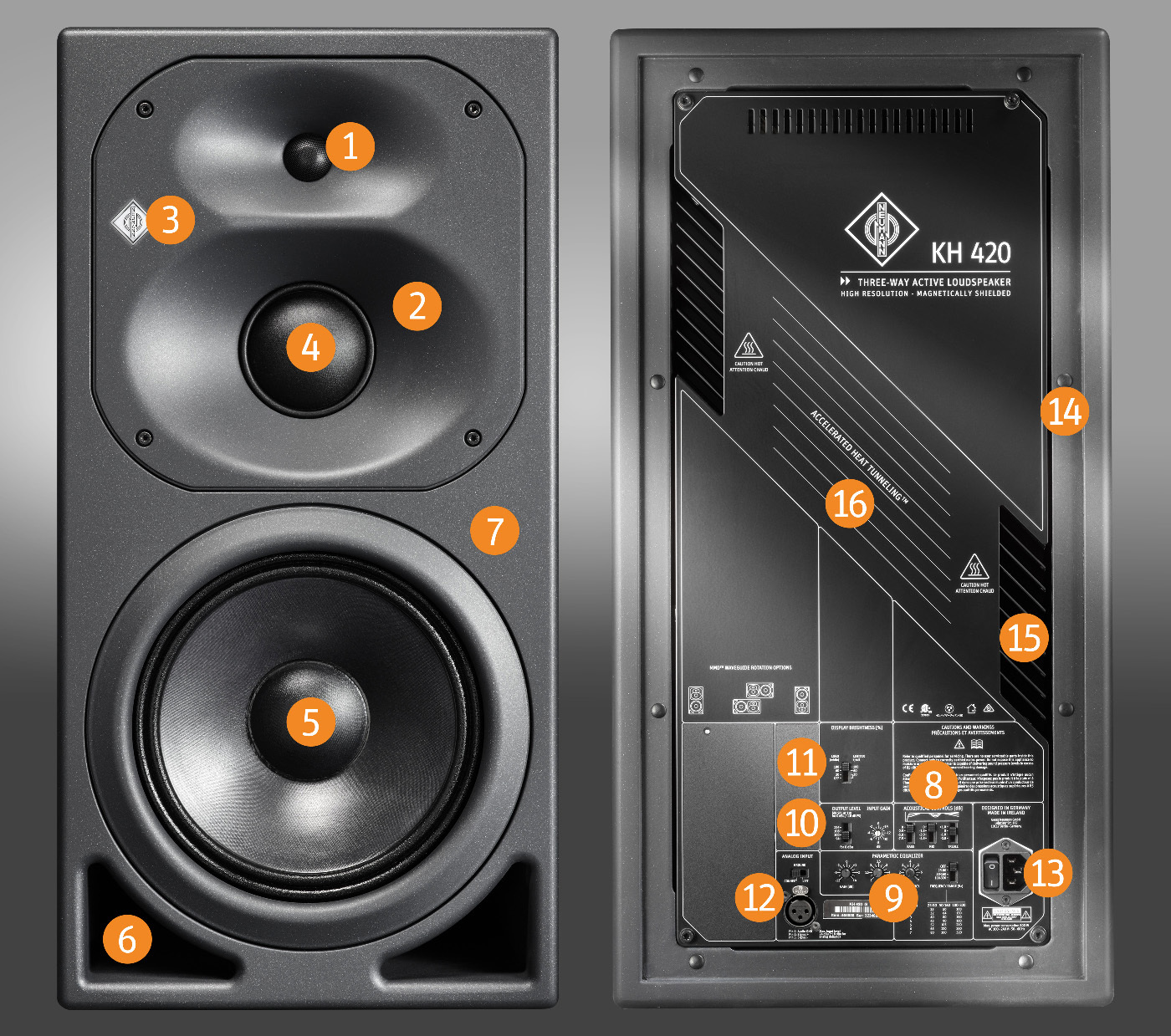
Collection description
- Seleccionar una opción actualiza la página completa.
- Se abre en una ventana nueva.